

Article: Sheepskin Cushions: How to Choose the Right Size and Style

Sheepskin Cushions: How to Choose the Right Size and Style
A sheepskin cushion is a more considered specification than it might appear. The pile type, backing, and size all affect how the cushion reads in the room and how it performs over time. Getting those decisions right for a client project — particularly when speccing a set — is worth thinking through before ordering.
This article covers the main decisions. For project quantities or specific scheme advice, contact details are at the end.

Pile type
The pile choice is the single most significant decision, and it should follow from the role the cushion is playing in the scheme.
New Zealand short-wool is the most versatile option. At 2–3 cm, it has a tailored, refined appearance that works in contemporary, Scandinavian, and transitional schemes. It is available in dyed colours, it holds its shape well, and it is the most practical choice for cushions that will be used regularly — sofa cushions, reading chair cushions, anything subject to daily handling.
New Zealand long-wool (5–7 cm) makes a more textural, tactile cushion. The deeper pile reads as more luxurious and is better suited to schemes where the cushion is an accent piece rather than a working element. It is also available dyed.
Tibetan sheepskin cushions are decorative in intent. The loose, open curl of the wool is striking and photographs particularly well, but the pile structure is not designed for frequent compression. For a sitting room where cushions are arranged rather than leaned against, Tibetan works well. For a family sofa in daily use, it will show wear faster than New Zealand wool.
Gotland sheepskin cushions have a defined, lustrous curl and a more sculptural quality than Tibetan. They are best understood as accent pieces — used in small numbers within a scheme to provide a point of textural interest.

Size
Standard sheepskin cushions typically come in 45×45 cm and 50×50 cm. For a sofa, 50×50 cm tends to read better as a standalone piece and sits more comfortably against the back of a deep cushion. For a reading chair or a bed, 45×45 cm is proportionally right in most situations.
Rectangular cushions — 50×30 cm or 60×40 cm — work well on beds and can introduce a horizontal element that breaks up a row of square cushions. They are also useful on benches and at the foot of beds where a square cushion would look out of proportion.
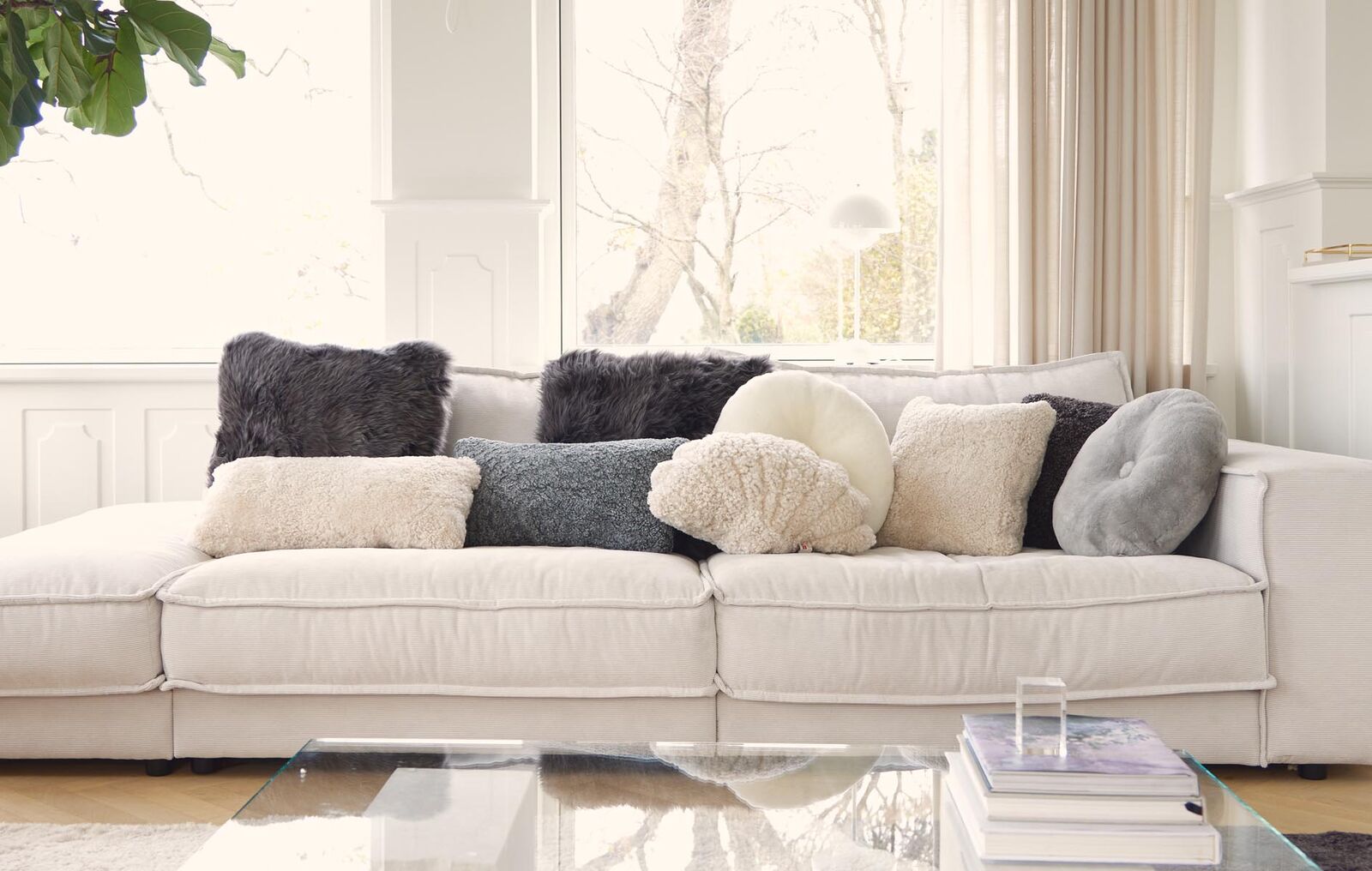
When speccing multiple cushions for a sofa, odd numbers usually read better than even. Three cushions of the same type — or two of one type and one of another — is a more natural arrangement than four identical pieces.

Backs and inserts
Sheepskin cushion covers are typically backed in a complementary fabric — suede, leather, or a tightly woven wool or linen. The back material affects both the visual finish and the practical performance of the cushion. A suede or leather back is durable and wipes clean easily, which matters on a sofa in a family home. A fabric back is softer and quieter but less resilient.
For the insert, a high-loft down or feather-and-down filling maintains the shape of the cushion and allows the wool pile to sit correctly. A firm foam insert tends to compress the pile unevenly and is generally not the right choice for sheepskin covers.
Mixing cushion types in a scheme
A single material throughout — all New Zealand short-wool in one colour, for example — reads as considered and deliberate. It is the right approach when the scheme is already texturally rich and the cushions are playing a supporting role.
Where the cushions are meant to carry more of the textural interest, mixing pile types within the same colour family works well: a New Zealand long-wool cushion alongside a Gotland or Tibetan piece introduces variation without introducing colour conflict. The different curl structures read as related but distinct.
What generally does not work is mixing pile types of very different scales in equal numbers — two Tibetan cushions and two short-wool cushions of the same size read as unresolved rather than layered. One statement pile type, supported by a simpler one, is the more reliable approach.

Working with us on a project
We supply cushion covers and complete cushions to trade clients and can advise on pile type, sizing, and colour matching for specific schemes. For sets of four or more, or for schemes where consistency across a batch is important, contact us before placing the order.
Email: hello@naturescollection.eu
Phone: +45 75 80 10 50
Read more
The Best Natural Materials for a Cosy Winter Home
Warmth in a winter interior is as much a material quality as it is a matter of heating. Rooms that feel genuinely cosy share a specific set of characteristics: tactile surfaces, natural fibres, mat...
Read more